
Data Centers
Smart Cooling. Smarter Outcomes.
Supporting the Infrastructure Behind AI
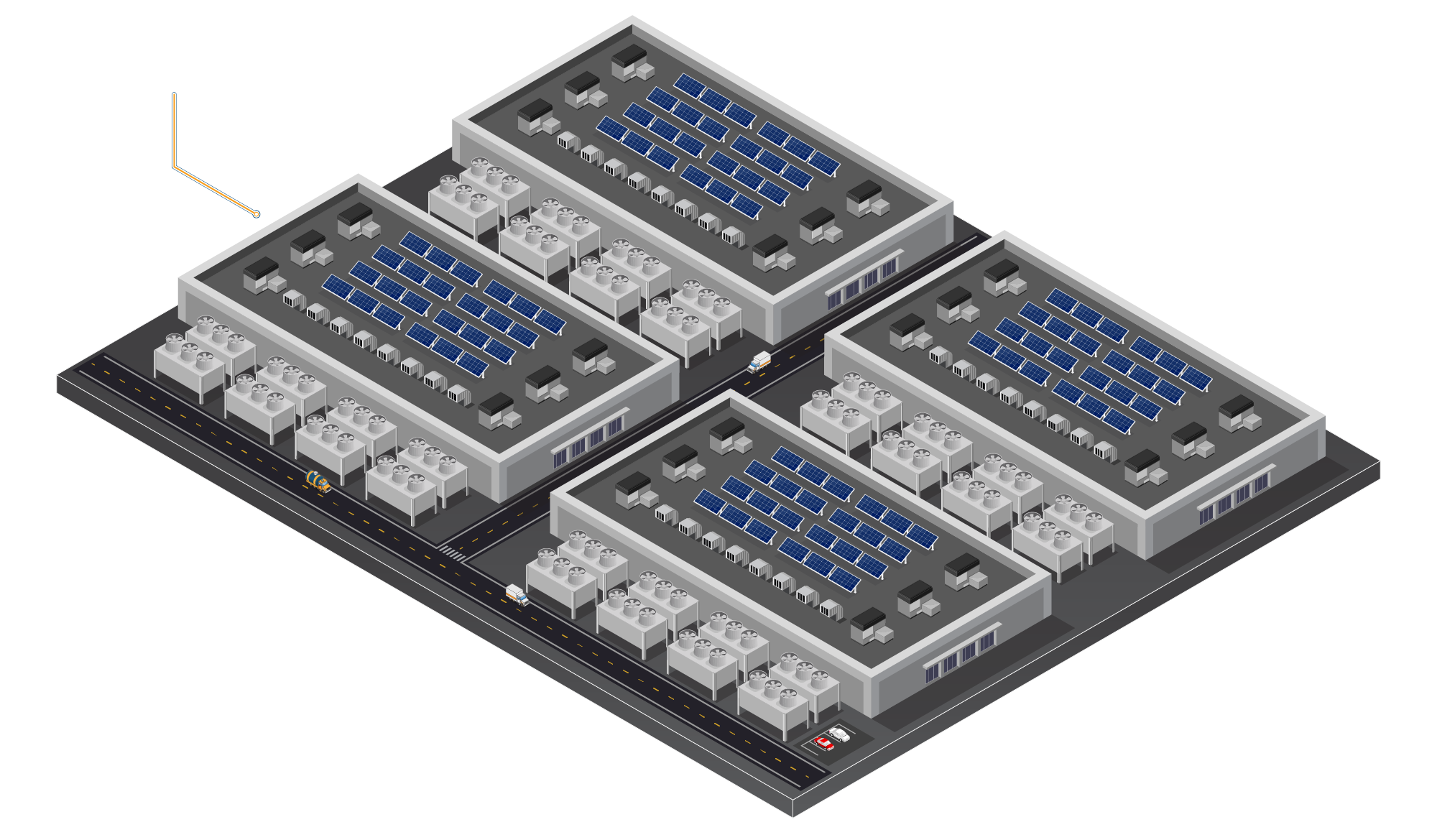
The global data center market is accelerating at an unprecedented pace, fueled by AI, hyperscale computing, and the relentless demand for digital infrastructure. But as rack densities rapidly approach 100 kW and higher cooling is no longer just a facility concern. It is mission-critical infrastructure.
At these power levels, a coolant leak isn’t a maintenance issue it’s a business risk. A single failure can put fluid on energized equipment, trigger unplanned outages, damage valuable hardware like High Performance Computers, and disrupt mission-critical operations. The root cause is often deceptively small: an undersized distribution header, an incompatible valve seat, a rushed solvent-cement joint installation. Yet the consequences are realized where uptime matters most, in the data hall.
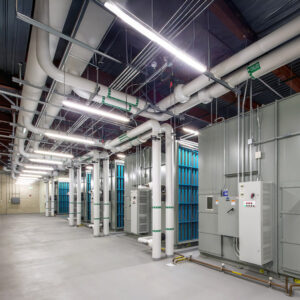
From chilled water systems and cooling towers to advanced direct-to-chip and liquid cooling architectures, Harrington delivers the engineered flow control solutions that keep AI infrastructure operating optimally. By ensuring reliable thermal management, leak-free fluid handling, and long-term system integrity, we help data centers maximize uptime, protect critical assets, and support the next generation of high-density computing.
Why Partner with Harrington?
Harrington Process Solutions is a thermoplastics and metals piping specialist, not a generalist. For decades we have supplied corrosion-resistant pipe, valves, instrumentation, and fluid handling systems to high-purity, corrosion-resistant, harsh & hazardous, and sanitary applications, in mission-critical environments, from semiconductor fabs to chemical plants. As data center infrastructure evolves, we bring that same discipline to the facility side of liquid cooling: the chilled water loops, CDU supply and return lines, storage, and distribution headers that connect your cooling plant to the rack. Our specialists work directly with engineers, contractors, and facility managers to design and implement scalable, sustainable systems, backed by local inventory, national distribution, and 24/7 support. When uptime is critical, Harrington is the partner you can trust to keep operations running.












Thermoplastic and Metal Piping Matched to Each Data Center Cooling Zone
The right liquid cooling piping for a data center is selected zone by zone, not by defaulting to one material everywhere. Our data center specialists help customers specify the right materials for each process:
- CPVC Schedule 80 for primary chilled water distribution. Service to 176°F (80°C) and glycol compatibility to 50% concentration at rated temperatures.
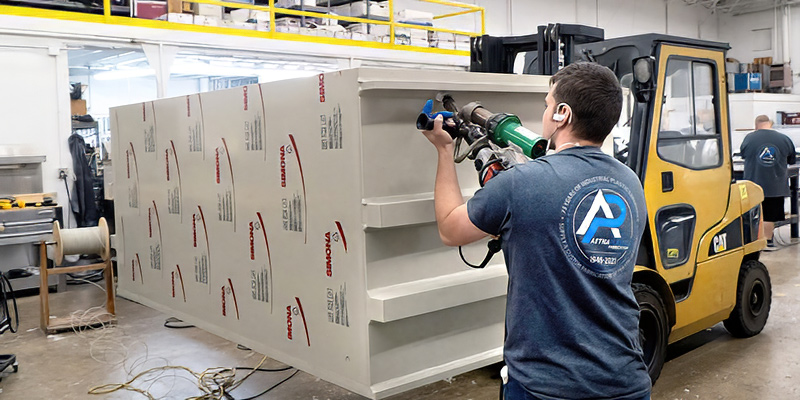
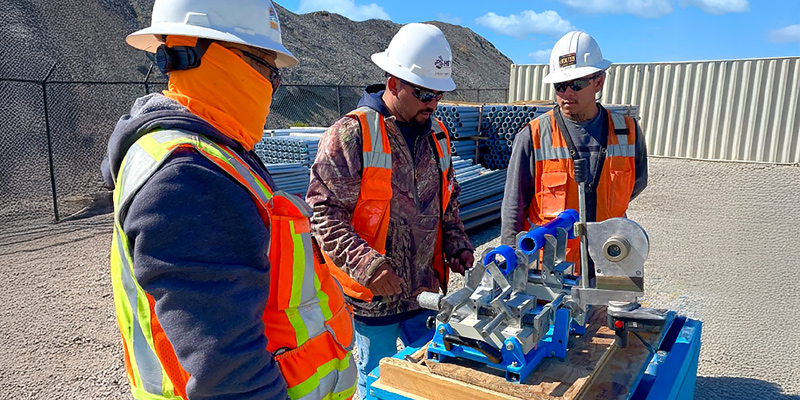
- PP-R for above-slab headers and runs over active server rows. Heat-fused joints create a monolithic, leak-path-free system rated for 60+ year service life. Harrington has installations rental equipment including fusion tools for proper installation.
- PVDF (Kynar) where deionized water, high-purity coolants, or aggressive chemistry are present.
- PVC Schedule 40 and 80 for secondary loops and lower-density utility runs.
- Double containment piping with leak detection that captures a breach before it reaches IT equipment and signals the BMS.
- Pre-assembled actuated valve packages for zone isolation, automatic shutoff, and N+1 failover, tested before shipment.
Explore Our Data Center Capabilities

Harrington Data Center FAQs
What causes leaks in data center process piping systems?
Leaks in data center process piping most commonly stem from five root causes: improper joint preparation, material-chemistry mismatches, inadequate pipe support, thermal expansion stress, and undersized distribution headers.
- Joint failure is the leading cause. Solvent-cemented PVC and CPVC joints fail when the wrong primer is used, cure time is rushed, wrong cement for size, or installation happens in cold or humid conditions. These joints are also vulnerable in high-glycol service concentrated propylene or ethylene glycol can degrade cement bonds over time. Heat-fused PP-R and PVDF joints, by contrast, create a monolithic connection with no mechanical weak points, making them the preferred choice above active server rows or anywhere a leak would cause downtime.
- Material-chemistry mismatches are the second most common cause. PVC is not compatible with high-concentration glycol at elevated temperatures, and standard elastomer seals in valves often fail before the pipe itself does. EPDM seals are generally preferred for propylene glycol service; FKM (Viton) for ethylene glycol. Specifying the wrong seat material in an otherwise correct valve is one of the most overlooked failure points in cooling system design.
- Thermal expansion in long straight runs particularly in PP-R and CPVC creates stress at fixed points if expansion loops or offsets aren’t engineered into the layout. This is especially common in large distribution headers added during capacity expansions.
- Undersized headers cause over-pressurization events. At 50kW+ rack densities, flow rate requirements increase significantly. Piping sized for traditional 10kW air-cooled racks will experience velocities and pressures that accelerate joint fatigue.
- Inadequate pipe support particularly on large-diameter PP-R headers leads to sagging, which stresses joints and misaligns equipment connections over time.
Harrington Process Solutions helps engineering teams avoid these failure modes through material selection support, glycol compatibility review, and actuated valve packages pre-assembled and tested before shipment. For facilities where a leak is unacceptable, Harrington also supplies double containment piping systems with integrated leak detection providing a secondary barrier and real-time alarm capability.
What are top liquid cooling piping options for large data centers?
Large data centers deploying liquid cooling have four primary thermoplastic piping options, each suited to different zones and performance requirements.
- CPVC Schedule 80 is the most widely specified material for primary chilled water distribution. It handles service temperatures up to 80°C, carries higher pressure ratings than standard PVC, and is compatible with propylene and ethylene glycol up to 50% concentration at rated temperatures. It’s solvent-cemented, making installation straightforward for experienced contractors, and it’s the cost-effective default for primary cooling loops in most colocation and enterprise data center builds.
- PP-R (Polypropylene Random Copolymer) is growing rapidly in hyperscale deployments. Its key advantage is heat fusion joining — joints are thermally welded to create a monolithic system with no adhesives, no VOCs, and no mechanical weak points. PP-R is rated for 60+ year service life, offers excellent glycol resistance across the full concentration range, and is significantly lighter than metal alternatives. It’s the preferred specification for above-slab primary headers and any run directly above active server rows. Fusion requires a trained operator and dedicated tooling; Harrington offers fusion tool rental to contractors nationwide.
- PVDF (Kynar) is specified where deionized water, high-purity coolants, or aggressive chemistry is present — common in life sciences-adjacent data centers and facilities with pharmaceutical co-location tenants. PVDF is also fusion-joined, carries excellent chemical resistance, and is the correct choice for secondary containment carrier pipes where dielectric fluids or specialty coolants are in use. Its higher cost is justified in these specific applications.
- PVC Schedule 40/80 remains appropriate for secondary distribution loops, non-critical utility runs, and below-raised-floor distribution in lower-density environments. It is not recommended above active server rows without double containment.
For high-density AI infrastructure at 50kW or above per rack, the correct default shifts to CPVC Sch.80 or PP-R across the board — flow rates, pressures, and temperatures at those densities exceed what standard PVC was designed for.
Harrington Process Solutions supplies all four materials across 85+ branch locations, with specialty group engineers available to support material selection, glycol compatibility review, and system design for both new builds and retrofits.
Which process piping systems are proven for mission-critical cooling?
In mission-critical liquid cooling environments, the most proven piping systems share three characteristics: fusion-joined or mechanically verified connections, material-chemistry validation for the specific coolant in service, and integrated valve automation for zone isolation and leak response.
- Heat-fused PP-R systems have become the benchmark for mission-critical primary distribution. With no adhesive joints, no VOCs, and a welded connection stronger than the pipe wall itself, PP-R eliminates the most common leak initiation point in thermoplastic systems. It’s specified by hyperscale operators for primary cooling headers, CDU supply and return lines, and any run where a leak would trigger a service event. Its service life and full glycol compatibility make it the lowest long-term risk option.
- CPVC Sch.80 systems are the proven standard in colocation and enterprise data centers — millions of square feet of data hall are currently cooled with CPVC primary loops. Properly cemented and installed to manufacturer specifications, CPVC is a reliable, cost-effective solution. It becomes the default when construction schedules, contractor familiarity, or budget constraints make PP-R fusion less practical.
- Double containment piping systems — a carrier pipe inside a containment pipe with continuous leak detection in the annular space — are increasingly specified for any run directly above active server rows, under-floor distribution in high-density zones, and CDU connection points. When a breach occurs in the carrier pipe, fluid is captured before it reaches IT equipment, and an alarm signal is sent to the BMS. These systems are available in PVC/PVC, PVC/CPVC, PVC/FRP, CPVC/CPVC, and PVDF carrier configurations.
- Actuated valve packages — automated isolation valves on every CDU feed and zone branch — are the operational backbone of a mission-critical liquid cooling system. They enable maintenance isolation without full-system shutdown, provide automatic shutoff on a leak detection signal, and support N+1 failover schemes for redundant CDU configurations. Electric actuators with position feedback and BACnet or Modbus integration are standard in tier 3 and tier 4 facilities.
Harrington Process Solutions supplies all components of a proven mission-critical cooling system: PP-R and CPVC pipe and fittings, double containment systems, pre-assembled actuated valve packages, and facility-loop instrumentation from a single source with engineering support and 90+ stocking locations.
Can you use PVC pipe for data center cooling loops?
Yes, in the right zones. PVC Schedule 40 and 80 is appropriate for secondary distribution, utility runs, and below-floor loops in lower-density facilities. It is not recommended above active server rows without double containment, and it should not be used in high-concentration glycol at elevated temperatures. For primary loops, CPVC or PP-R is the better choice.
Is PP-R or CPVC better for data center chilled water?
Both work for primary chilled water; the difference is the joint. CPVC Sch.80 is solvent-cemented, lower in cost, and familiar to most contractors. PP-R is heat-fused into a monolithic system with no adhesive leak paths, which is why hyperscale operators favor it above active rows. PP-R requires trained fusion operators and tooling, which Harrington rents nationwide.
What pipe materials are compatible with glycol cooling loops?
CPVC and PP-R both handle propylene and ethylene glycol; CPVC is rated to roughly 50% concentration at temperature, while PP-R resists the full concentration range. PVDF offers the highest resistance for specialty coolants. The most overlooked failure point is the valve seal, not the pipe: match EPDM to propylene glycol and FKM to ethylene glycol.
When is double containment required for data center coolant piping?
It is code-driven in some jurisdictions and best practice in others. Treat it as the default above active server rows, under-floor distribution in high-density zones, and at CDU connection points, anywhere a leak would reach live equipment. The system pairs a carrier pipe with a containment pipe and continuous leak detection that signals the BMS.
How does rack density affect cooling pipe sizing?
Higher density means more flow, which means larger pipe. At 50kW+ per rack, piping sized for traditional 10kW air-cooled racks runs at velocities and pressures that accelerate joint fatigue and risk over-pressurization. Hold velocity to roughly 5 ft/s in thermoplastic systems and size headers accordingly.
What is a CDU and how does it connect to facility piping?
A coolant distribution unit receives facility chilled water and conditions it for rack-level cold plates, isolating the building loop from the IT-side coolant loop. The facility side, the supply and return lines that connect to the CDU, is standard thermoplastic process pipe in Harrington’s range, typically 2″ to 6″ at the row level with isolation and balancing valves.
Do I need actuated valves on a liquid cooling loop?
For any zone that needs remote shutoff, sits on a leak-detection interlock, or supports N+1 failover, yes. Manual valves are fine for low-criticality secondary loops and maintenance points. Harrington builds pre-assembled actuated valve packages, wired and tested, with BACnet or Modbus integration.
How To Work With Harrington
- Share Your Specs. Send us your cooling approach, rack density, coolant chemistry and glycol concentration, temperatures, and pressures. A rough single-line drawing is enough to start.
- Engineering Review. Our data center specialists confirm material and seal compatibility, size headers to velocity limits, and configure valve and instrumentation packages.
- Stocked Delivery And Support. We supply pipe, fittings, valves, and tested assemblies from regional inventory, with fusion tool rental and technical support through the project.
Specifying the wrong material, seal, or header size is invisible until it leaks, and by then it is an outage. Getting it right at specification time is the difference between a system you monitor and one you trust. Call our toll-free number at 1-800-213-4528 and you will reach a live data center specialist, not a recording. You may also use the contact form below, or request a quote with your cooling approach, rack density, and coolant details.
Need answers from a trusted source?
Call our toll-free number at 1-800-213-4528 and you will be connected to a live person – not a recording.
You may also use the contact form below for any questions regarding our products and services.