Data centers rely on precision, performance, and reliability and the piping materials that move cooling fluids through these systems play a vital role in all three. Selecting the right material isn’t just about temperature or flow rate; it directly impacts uptime, energy efficiency, and long-term maintenance costs.
In this guide, we’ll break down the most common materials used in data center cooling systems, compare their strengths, and explain how Harrington’s design team helps facilities engineer piping networks built for performance and longevity.
Common Piping Materials for Data Centers
Not all piping is created equal. In high-stakes environments like data centers, where every degree of temperature and every minute of uptime matters, the right choice of material can make the difference between consistent operation and costly downtime.
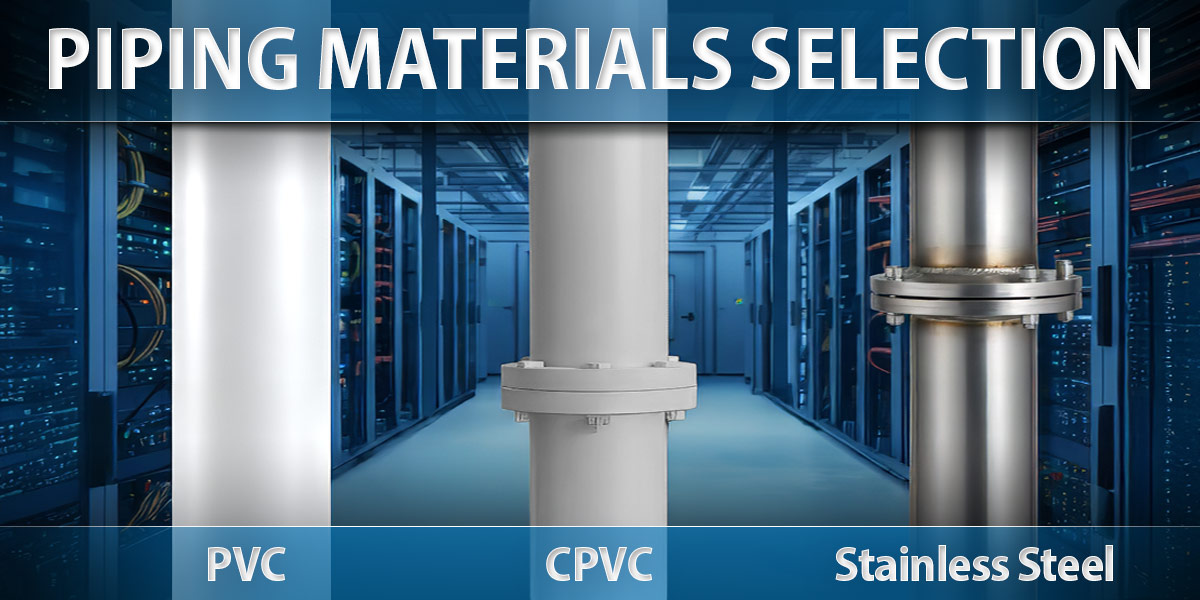
Here are three of the most common materials used in modern data center infrastructure projects.
1. PVC (Polyvinyl Chloride)
PVC is one of the most widely used materials in industrial and mechanical systems. It offers strong corrosion resistance and smooth internal surfaces that minimize frictional losses, which is ideal for chilled water systems.
Advantages:
- Excellent chemical and corrosion resistance
- Lightweight and easy to install
- Cost-effective compared to metal alternatives
Limitations:
- Lower temperature and pressure tolerance than CPVC or stainless steel
- Not suitable for applications above 140°F
Best Use Case:
Secondary cooling loops, non-critical chilled water distribution, and low-temperature systems where cost efficiency matters.
2. CPVC (Chlorinated Polyvinyl Chloride)
CPVC provides many of the same benefits as PVC but performs better in environments with higher temperatures and pressure.
Advantages:
- Handles fluid temperatures up to 200°F
- Strong chemical resistance and low thermal conductivity
- Lower material cost than metal piping
- Provide long reliable system performance when installed with the approved CPVC cements and primers and is properly supported.
Limitations:
- Slightly higher cost than PVC
- Requires careful handling during installation to prevent stress cracking
Best Use Case:
Primary cooling loops, heat exchanger lines, and systems where both temperature and reliability are critical.
When paired with Harrington’s data center cooling solutions, CPVC piping can deliver outstanding performance and long-term stability.
3. Stainless Steel
Stainless steel remains a go-to choice for facilities prioritizing strength and long-term durability. It’s commonly used in mission-critical systems or where regulatory and safety standards require metal piping.
Advantages:
- High pressure and temperature tolerance
- Excellent mechanical strength
- Long service life and minimal expansion or contraction
Limitations:
- Expensive materials and installation
- Can corrode under certain untreated water chemistries
Best Use Case:
Main distribution lines, high-temperature applications, or systems requiring additional safety or structural integrity, which are often integrated with engineered plastic components for hybrid performance.
Piping Material Comparison
Property | PVC | CPVC | Stainless Steel |
Temperature Range | Up to 140°F | Up to 200°F | 300°F+ |
Pressure Rating | Up to 150 psi | Up to 200 psi | 300+ psi |
Corrosion Resistance | Excellent | Excellent | Good (depends on fluid chemistry) |
Cost | Low | Moderate | High |
Installation Ease | Easy | Easy | Difficult |
Service Life | 15–25 years | 20–30 years | 30+ years |
Maintenance Needs | Minimal | Minimal | Moderate |
This table illustrates why CPVC often represents the ideal middle ground for most modern data centers: balancing durability, corrosion resistance, and affordability.
Energy & Maintenance Impacts
Energy efficiency doesn’t start with servers or HVAC units; it begins with the materials that move coolant throughout the facility. Poorly selected piping can lead to inefficiencies such as:
- Increased frictional loss and pump energy usage
- Heat transfer inefficiency
- Unexpected downtime due to corrosion or leaks
PVC and CPVC offer excellent insulation properties that reduce energy loss compared to metal pipes, while stainless steel is better for systems exposed to frequent thermal cycling or high pressure.
When integrated properly with Harrington’s mechanical design services, material selection can directly improve:
- Operational Costs: Reduced energy demand lowers cooling expenses
- System Reliability: Less corrosion = fewer leaks and failures
- Maintenance Scheduling: Longer life expectancy and simplified upkeep
How Harrington Helps with Piping Material Selection
Every data center project begins with understanding system loads, cooling loop design, and long-term performance requirements. Harrington’s engineering and supply experts collaborate with contractors and facility teams to evaluate:
- Flow rate and heat load dynamics
- Pressure and temperature thresholds
- Material compatibility with specific cooling fluids
- Installation environment and accessibility
By combining decades of experience in industrial piping and fluid handling, Harrington ensures every design choice aligns with both performance goals and budget requirements.
Whether your facility needs CPVC chilled water systems or hybrid metal-plastic piping networks, our team delivers complete data center infrastructure solutions built for efficiency, reliability, and scale.
Conclusion
Selecting the right piping material for a data center isn’t just a design decision; it’s a performance investment. From corrosion resistance to thermal efficiency, every factor contributes to system uptime and sustainability.
Ready to start your next data center project?
See how Harrington’s Data Center Design Services and Cooling Solutions can help you create an infrastructure that performs as reliably as the systems it supports.